Podcast episode
September 25, 2026
Episode 221: Prolegomena to the Development of the Shī‘a and of Shī‘ī Esotericisms in the Eighth Century and Beyond
We return to the shī‘a and discuss many (hopefully) useful contextual matters.
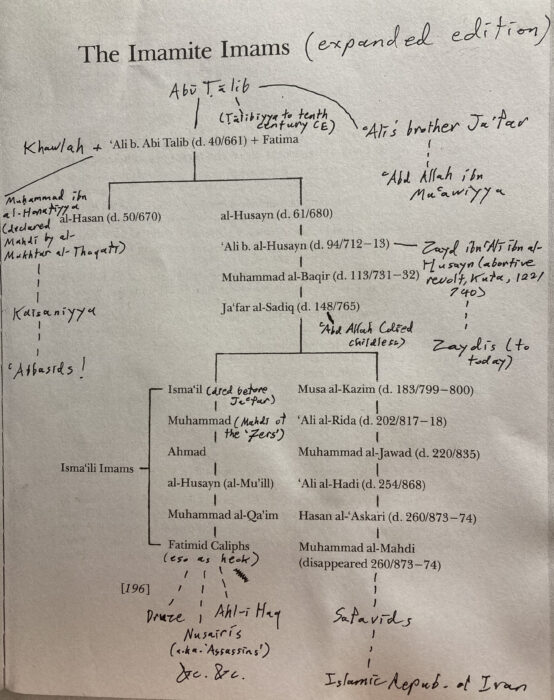
Works Cited in this Episode:
Michael G. Morony. Iraq after the Muslim Conquest. Princeton University Press, Princeton, NJ/Guildford, 1984.
Abdulaziz Abdulhussein Sachedina. Islamic Messianism: the Idea of Mahdī in Twelver Shī‘ism. State University of New York Press, Albany, 1981.
Recommended Reading:
SHWEP Episode 221 Recommended Reading
Themes
‘Alī ibn Abī Ṭālib, Druze, Esoteric Hermeneutics, Ghulāt, Isma‘ilism, Ithna`asharī Shī`ī, Ja‘far al-Ṣādiq, Mahdism, Shi‘ī Esotericism, Zaydis

Kenneth Meisner
September 25, 2026
Thank you! Looking forward to the next installment in this series, particularly as I too am desirous of hearing more about the Shi’i traditions that didn’t survive. Also glad I just relistened (more than once) to the episodes with Ahab Bdaiwi just before this dropped. (I was just about to relisten to them again when I noted this episode had posted.)
I’ve a couple questions/comments, if I may.
Q1. At about the 10-11 minute mark, you mention polytheists “seemingly” living in Iraq. Several months ago, I read Gabriel Said Reynolds’ “Christianity and the Qu’ran: the rise of Islam in Christian Arabia” (Yale University Press, 2025) in which he posits the idea that the “polytheists” mentioned in the Qu’ran were actually Christians, so I’m wondering who these Iraqi polytheists might’ve been (and of course, whether they were Christians or no, what their contribution to esotericism might’ve been).
Q2. For whatever reason, the “recommended readings” list is quite small and, to my 55-year-old eyes, a bit painful. When magnified, the text is blurry. Is this just a me problem?
Q3. I had no trouble listening to the audio from beginning to end, but when, on a second listen, I attempted to “rewind” although the timer was running, the sound didn’t come through. I tested fast-forwarding too, and had the same problem. I checked it out on other episodes and didn’t experience this problem.
Regardless, thank you!
Claus Hollenberg
September 25, 2026
I have not read Reynolds’ book, but it is rather clear that the Qur’anic Associators (mushrikun) weren’t polytheists at all, but worshippers (of one kind or other) of the biblical god, to whom they associated traditional Arabic deities as subordinate partners. The ground-breaking work on this was of course Gerald R. Hawting, The Idea of Idolatry and the Emergence of Islam: From Polemic to History. Cambridge: Cambridge University Press, 1999. Several of Patricia Crone’s last articles are also very pertinent here.
In Iraq, there „seemingly“ were still surviving adherents of the traditional Mesopotamian religion around at the time of the Islamic conquest of the former Sasanian realm (similar to the Harranians on the former East Roman side). The main study of them is (the late) Jaakko Hämeen-Anttila, The Last Pagans of Iraq: Ibn Wahshiyya and his Nabataean Agriculture. Islamic History and Civilization 63. Leiden: Brill (yes, again), 2006.
As for the Recommended Reading list, if you click on the blurry picture, you will be taken to a much more readable two-page PDF.
I often get problems with the audio when trying to rewind within a SHWEP episode. Best close the browser, start anew and jump directly to the part you want to hear again.
Kenneth Meisner
September 25, 2026
Thank you, Mr Hollenberg! Very much obliged. Both titles are now on my reading list. I can at least justify acquiring Hawting’s book.
Also thank you for revealing the secret knowledge of the fuzzy image. Regarding the recording, unfortunately, even attempting to start the audio according to your suggestion anywhere other than the beginning fails. Moreover, I just found out that even pausing this video prevents my further listening. Quite the puzzlement.
Again, thank you!
Earl Fontainelle
October 9, 2026
Dear Kenneth (and everyone),
I have been getting a few complaints about the audio-player plugin we’re using. I think it should be easy enough to change it out for one that works better, and am looking into it. I’d like a ‘fast forward ten seconds’ feature as well. Watch this space.
I hope the polytheists question is answered to your satisfaction: we are indeed talking about just traditional near-eastern polytheists of various kinds still doing their thing in Mesopotamia. Some, like the Harranians, were fortunate enough to have been able to become Ṣabæans and go on thriving in the Islamic era. Others presumably just dwindled or converted out of existence, such that they disappear from our records.
Kenneth Meisner
October 9, 2026
Very good on both points. Thank you!