Podcast episode
February 25, 2026
Episode 213: Philosophy and Occult Sciences at Constantinople: Maria Papathanassiou on Stephanos of Alexandria, Part I
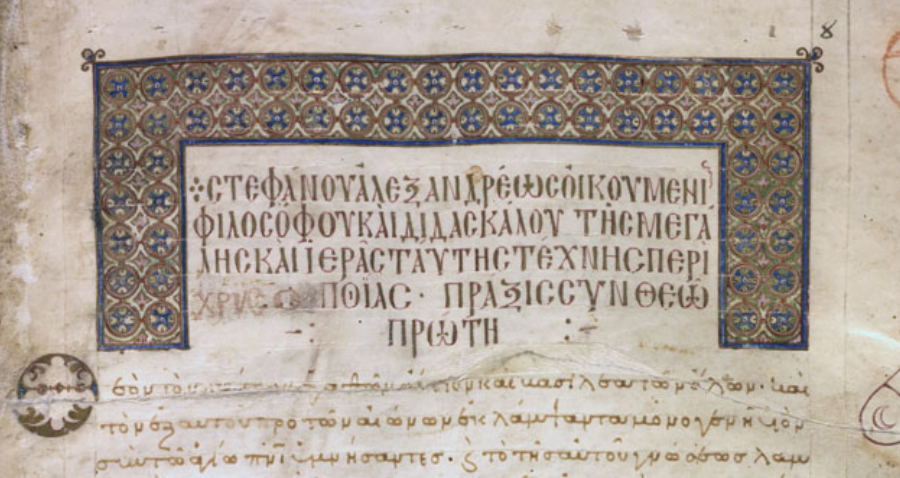
We are delighted to speak with Maria Papathanassiou, who has devoted a considerable portion of many decades of work to decoding the remnants of the prodigious scientific and philosophical output of Stephanos of Alexandria. There is so much in this interview that we have divided into two parts but, like Stephanos’ occult-scientific-philosophic synthesis, the parts form an organic whole. Be sure to download this slideshow and follow along:
STEPHANOS podcast powerpoint
Among many topics discussed in Part I, we cover:
- What we know of Stephanos’ biography (including his education at Alexandria, one of the final students of section of the Golden Chain represented by Ammonios Hermeiou, and his move to Constantinople, where he taught the quadrivium under the patronage of the emperor Herakleios)
- His works, including commentaries on Aristotelean works, lost Platonic commentaries, an important alchemical work entitled The Procedure of the Great and Holy Art of Gold-Making (τῆς μεγάλης καὶ ἱερᾶς ταύτης τέχνης περὶ χρυσοποιΐας πρᾶξις), a practical astronomical work (a Commentary on Ptolemy’s Handy Tables as edited by Theon of Alexandria), and an astrological treatise entitled ‘Astrological Procedure’ (Ἀποτελεσματικὴ πραγματεῖα), which features an absolutely unique piece of astrological lore, a ‘horoscope of Islām’ in which Stephanos, at the request of a friend, casts a chart for the mysterious new religion which has appeared on the Roman horizon in recent years.
- As a bonus, in what you might call a collaborative work of astronomy/astrology (and even alchemy!) between Stephanos and Dr Papahanassiou, she walks us through a passage in Stephanos’ alchemical lectures where he describes a stellar observation made at Constantinople, the processes by which this observation could be pinpointed in time, and the relevance this solid data-point has for dating Stephanos’ life and works:
Again the [planet] of Venus attained the Persian dawn and precedes the rays of the Sun; again the [planet] of Mercury,under the rays of the Sun, is found in the subsequent [Zodiacal signs]; again the [planet] of Saturn is faintly discernible due to the steepness of its height; again the [planet] of Mars ispreparing the burning cut; towards these [planets] comes the Moon dressed as a bride [and] takes up the towed ships of thenine parts; by means [of the Moon] the alloy that is in the process of mixing itself does so to perfection (trans. Papathanassiou 2006, text ldeler 225, 25-32).
- Having discussed this dating, we then turn to Stephanos’ occult-scientific project, integrating the mathematical sciences, astrological theory, Galenic medicine, alchemical ideas concerning the nature of matter, and symbolism drawn from the Orphic doctrines favoured by the Late Platonist philosophers following Proklos. The world of Stephanos is an interconnected world of correspondences; cue western esotericism in its full mediæval flowering.
Interview Bio:
Maria Papathanassiou is Professor Emerita in the Dept of Mathematics at the Kapadistrian and National University of Athens. Her publications include numerous studies in ancient and medieval exact sciences, the standard edition of Stephanos’ alchemical work, numerous studies of his other writings (see Recommended Reading bibliography), and much more.
Works Cited in this Episode:
Primary:
The stellar observation from the alchemical work can be found in ldeler’s edition at 225, 25-32: Stephanos of Alexandria. Οn the Great and Sacred Art of Making Gold. In J. L. Ideler, editor, Physici et medici græci minores, pages 199–247. Leipzig, 1842. Reprinted Amsterdam 1963.
Secondary:
O. Neugebauer and H. B. van Hoesen. Greek Horoscopes. American Philosophical Society, Philadelphia, PA, 1959.Greek Horoscopes
Recommended Reading:
SHWEP Episode 213-214 Recommended Reading
Themes
Alchemy, Astrology, Astronomy, Interview, Isaac Newton, Late Platonism, Medicine, Orthodoxy, Stephanos of Alexandria


Comments
Comments are open to SHWEP members only
Join now to comment
Already a member? Log in here