Podcast episode
December 7, 2025
Episode 212: Esoteric Orthodoxy in East Rome: Jonathan Greig on Maximus the Confessor
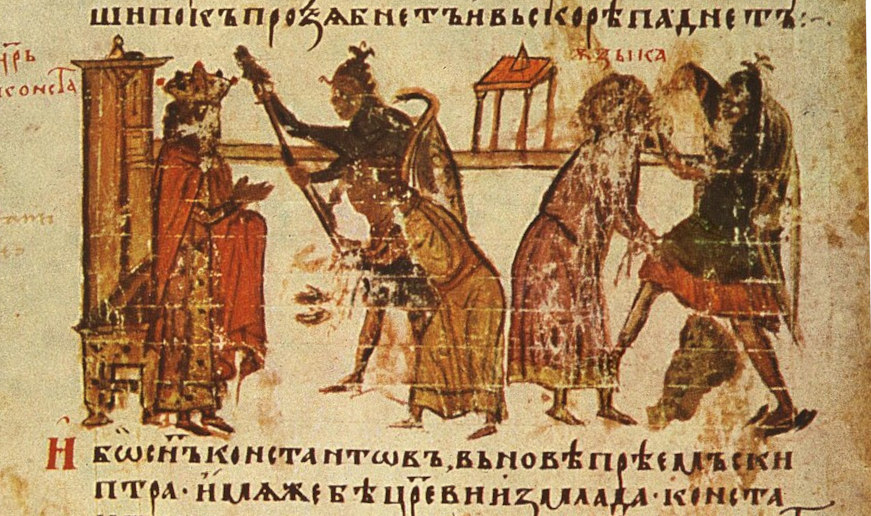
Maximus the Confessor, Μάξιμος ὁ Ὁμολογητής (late sixth century – 13 August 662), was an erudite monk, theologian, and philosopher of the East Roman empire; during his eventful life he travelled the soon-to-be-Arab territories of North Africa and the Near East (as well as visiting Rome, currently under the theoretical control of Constantinople via the Exarchate of Ravenna, which was in the process of being dismembered by squabbling warlords and marauding Lombards) and spent some time in Constantinople, before ending his life in exile in Georgia. Little, however, is sure about his biography, inasmuch as we have two competing Lives of Maximus, one Greek and one Syriac, which differ on crucial details. What is certain, however, is that after a life in the thick of the ongoing Christological conflicts inherited from the fifth century (or even farther back), his reputation ended in one of gold-standard Orthodoxy, deep theological acumen, and mystical insights.
He wrote widely, and we discuss the major genres in which he wrote, along with some of his crucial works. We then turn to a detailed exploration of Maximus’ complex philosophical debts to the Cappadocian Fathers, the Pseudo-Dionysios, but also (pretty definitely) to Proclus, and (possibly) Damascius, among other Late Platonist philosophers. What emerges is a certain confluence of ascetic praxis, participatory metaphysics, and highly-apophatic unsaying of god which will come to put a distinctly Maximus-flavoured stamp on Orthodox ‘mysticism’ going forward. There are various discursus in the conversation, as we delve into the Christological disputes which got Maximus into so much trouble, over the question of Christ’s faculty of will and whether he had a single will, human and divine (‘monothelitism’), or whether each of his two natures had its own will, as well as musing on the liminal politico-religious role played by monks and ascetics in Orthodox Christianity and the East Roman state. Finally, we discuss Maximus’ apophatic approach to god’s (non)nature; unlike Gregory of Nyssa, for whom god was an unlimited sea of being, god is, for Maximus, beyond being altogether. Late Platonist strong transcendence meets the direct encounter with the theandric Christ, and Orthodoxy will never be the same.
 Interview Bio:
Jonathan Greig is a postdoctoral researcher on the project: Visions of the History of Greek Philosophy in Late Antiquity and the Arabic and Greek Middle Ages at the Humboldt University of Berlin. He is currently working, with colleagues, on a translation of Maximus’ Disputatio cum Pyrrho for Anna Marmodoro and Johannes Zachhuber’s Library of Early Christian Philosophy series for the Oxford University Press.
Works Cited in this Episode:
Primary:
Maximus the Confessor. 2018. On the Difficulties of the Church Fathers. The Ambigua. Edited and translated by Nicholas Constas. 2 vols. Dumbarton Oaks Medieval Library. Harvard University Press:
- Ambiguum 7 (vol. 1): on Maximus’ doctrine of the logoi, critique of 6-7th-cent. CE Origenists, and argument against the soul’s (and body’s) pre-existence. (on that note, Epistle 6 (Migne, PG 91: 424–433) and (esp.) 7 (Migne, PG 91: 433–439) are relevant. (Unfortunately, no known full modern translation exists of these; but they are discussed in Benevich 2009 and Krausmüller 2016).
- Ambiguum 42 (vol. 2): more on Maximus’ argument against the soul’s pre-existence/for its persistence.
For the Centuries see Maximus the Confessor. 2017. Maximus Confessor. Capita theologica et oeconomica. Zwei Centurien über die Gotteserkenntnis. Edited by K. Hajdú and A. Wollbold. Fontes Christiani 66.
Origen:
- Condemned for (allegedly) teaching a spherical resurrection-body: see Henry Chadwick. Origen: Contra Celsum. Cambridge University Press, Cambridge, 1953, p. 95.
- Says things about the doctrine of the resurrection which seem to point in the direction of an esoteric teaching left unsaid: e.g. Comm. Joh. XIX.15.19. Cf. Cels. III.60 (not resurrection specifically, just statements that Jesus was even more esoteric than Plato), Cels. VI.6, commenting on Apoc. John.
Secondary:
Phil Booth, editor. Crisis of Empire: Doctrine and Dissent at the End of Late Antiquity, volume 52 of Transformation of the Classical Heritage. University of California Press, 2014.
Jonathan Greig. Proclus’ Doctrine of Participation in Maximus the Confessor’s Centuries of Theology I.48–50. In Markus Vinzent, editor, Studia Patristica LXXV, pages 137–48. Peeters, Leuven, 2017.
Jonathan Greig. Proclus’ Reception in Maximus the Confessor, Mediated through John Philoponus and Pseudo-Dionysius: A Case Study of Ambiguum 7. In Dragos Calma, editor, Reading Proclus and the Book of Causes, Volume 3, pages 117–67. Brill, Leiden, 2022.
Polycarp Sherwood. The Earlier “Ambigua” of Saint Maximus the Confessor and His Refutation of Origenism. Orbis Catholicus, 1955.
Recommended Reading:
SHWEP Episode 212 Recommended Reading
Themes
Ammonios Hermeiou, Apophatic Writing, Asceticism, Cappadocian Fathers, Damascius, Divinisation, East Rome, Gregory of Nazianzus, Henads, Interview, Late Platonism, Liber de causis, Maximus the Confessor, Michael Psellos, Monophysitism, Origen of Alexandria, Origenism, Proclus, Pseudo-Dionysios, Subtle Body, Theology of Aristotle


Julian Castillo Salcedo
March 17, 2026
Omg this guy is a really bad speaker, very hard to follow for a non native anglophone. Not only has he very bad diction but also interrupts his own phrases with “so… yeah” and such. He really needs to upgrade his orator skills.