Members-only podcast episode
The Play’s the Thing: Matthew Vadnais on (Ancient) Theatre, Initiation, and the Esotericism of Public Performance
This is a special podcast episode for SHWEP members only
Already a member? Log in here to view this episode
‘What [Aristotle] is up to in the Poetics is, I would argue, an argument pretending to be a sober assessment.’
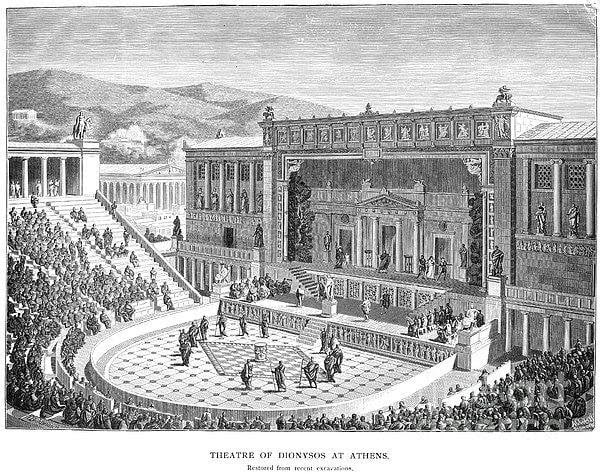
In our interview with Richard Seaford on the ancient mystery-cults some reference was made to Euripides’ play Bacchæ, as well as to Aristophanes’ Frogs. These plays (and the ‘culture wars’ surrounding them in ancient Athens) are crucial data for what went on in the ancient mysteries, Bacchic and Eleusinian in particular. In this episode we pull on those dramatic threads in greater detail from the perspective of theatre studies, exploring how aspects of the esoteric can be present in that most public of fora, the dramatic stage, and how an appreciation of this can help us understand the discourse of the esoteric and esotericism more broadly.
Dramatis Personæ (all dates BCE):
Æschylus (c. 525/524 – c. 456/455)
Euripides (c. 480 – c. 406)
Aristophanes (c. 446 – c. 386)
Plato of Athens (c. 428–423 – 348/347)
Aristotle of Stagyra (384 – 322)
Interview Bio:
Matt Vadnais teaches theater history at the University of Wisconsin Milwaukee. He is the author of All I Can Truly Deliver (del Sol, 2005) and has published essays regarding evidence of writing to ease the burdens of early modern performance practices in Shakespeare’s printed play texts.
Works Cited in this Episode:
Episode 26 with Peter Struck on symbols can be found here.
Episode 38 on the Esoteric Aristotle, Part I, can be found here.
Schechner, ‘an action twice performed’: Schechner, Richard. “Behavior, Performance, and Performance Space.” Perspecta, vol. 26, 1990, pp. 97–102. JSTOR, https://doi.org/10.2307/1567156. Accessed 16 June 2026.
A Game at Chess by Thomas Middleton: first performed in London in 1624
Augusto Boal Theatre of the Oppressed: https://en.wikipedia.org/wiki/Theatre_of_the_Oppressed
An eagle dropped a tortoise on Æschulus’ head: e.g. Pliny, H.N. 10.3.

Kell Drinkwater
June 26, 2026
If Dr. Vadnais is checking the comments here, I’d love to know where one can read more about the political readings of Hamlet, versus the psychological ones.
(And there’s definitely something related to say about the way religion and magic have been individualized and psychologized, which makes them less dangerous.)
Killer episode, makes me wish my high school English class had any of this wild and fascinating context about Greek drama!
James Butler
July 30, 2026
Just caught up with this excellent episode: thanks! (Is there an email notification I can sign up to for Members’ episodes / etc? — obviously they don’t ping the main feed and I’m spotty about checking the website.)
Dr Vadnais’s remarks about comedy and tragedy had me thinking about Euripides, and in particular his skill in drawing out the strangeness from a story by adding time to it. The Alcestis, for instance, is essentially a comic story which becomes uncomfortable and weird because of the gap between promise and execution (i.e. – I offer to save my husband’s life by dying in his place, but realise in the twenty years’ reprieve he’s actually kind of an awful guy.)
Alcestis ends with a return from the dead, and prompts a reflection about ‘theatrical miracles’, especially in early modern theatre. Shakespeare’s Winter’s Tale is the classic one – probably he knew a Latin version of the Alcestis – in which Hermione returns to life (in a sense) at the end. I.e.: she has secretly survived, and is posed as a statue on stage, and Paulina – a theatrical impresario-magician character – stages a ‘miracle’ in which the statue comes alive.
Think about what we have here: an audience watching a piece of theatre, in which a character constructs a piece of theatre to perform a miracle, which is carefully underlined as theatre *but which also has all the qualities of a true miracle*, not least in its emotional – cathartic! – effect on the audience. The boundaries between the two a very porous. And Paulina’s speech is very conscious of its (analogically, truly?) magical status, but as ‘lawful’ magic:
”Tis time; descend; be stone no more; approach;
Strike all that look upon with marvel. Come,
I’ll fill your grave up: stir, nay, come away,
Bequeath to death your numbness, for from him
Dear life redeems you. You perceive she stirs:
Start not; her actions shall be holy as
You hear my spell is lawful: do not shun her
Until you see her die again; for then
You kill her double. Nay, present your hand:
When she was young you woo’d her; now in age
Is she become the suitor?’
So much of its effect (it is very very moving on stage) is to do with – as Dr Vadnais suggests – actual physical bodies acting it out. And, historically, it was performed in the first wave of indoor theatres, lit by candles – so perhaps with an audience who cannot tell, initially, whether it’s ‘really’ a statue come to life or otherwise.
On the question of ritual and ritual theatre, at the end of this discussion: in London, recently, the Punchdrunk theatre company ran an (astonishing, hugely high-budget) Greek myth immersive performance, which included a deep, structuring engagement with Orphic themes. I’m sure at least some SHWEP listeners must have experienced it. In my professional life I wrote a little about it here: https://www.lrb.co.uk/blog/2023/august/at-one-cartridge-place
Earl Fontainelle
July 31, 2026
James, go to the main SHWEP page and click the icon that says “Email”. You’ll get an email every time we post something. I’ll leave the more interesting content of your message to Dr Vadnais to address ….
James Butler
July 31, 2026
Embarrassingly, I must have scrolled past that part of the footer dozens of times. He who has eyes to see, let him see!