Roots of Magic episode
February 4, 2026
Martin Stadler on Magic and Religion at the Ancient Egyptian Temple of Edfu
Roots of Magic Interview 9
[Be sure to scroll down and look at the images!]
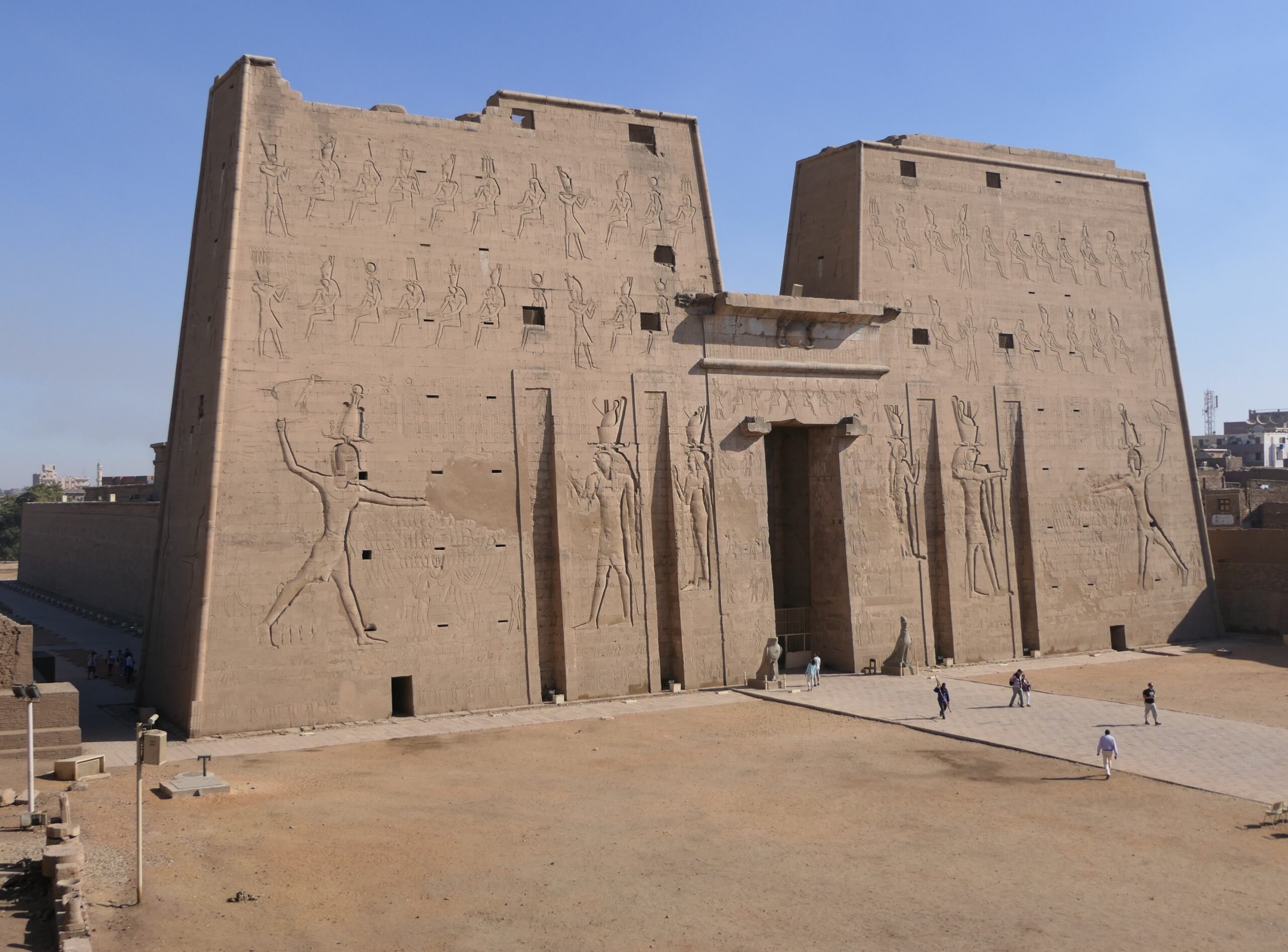
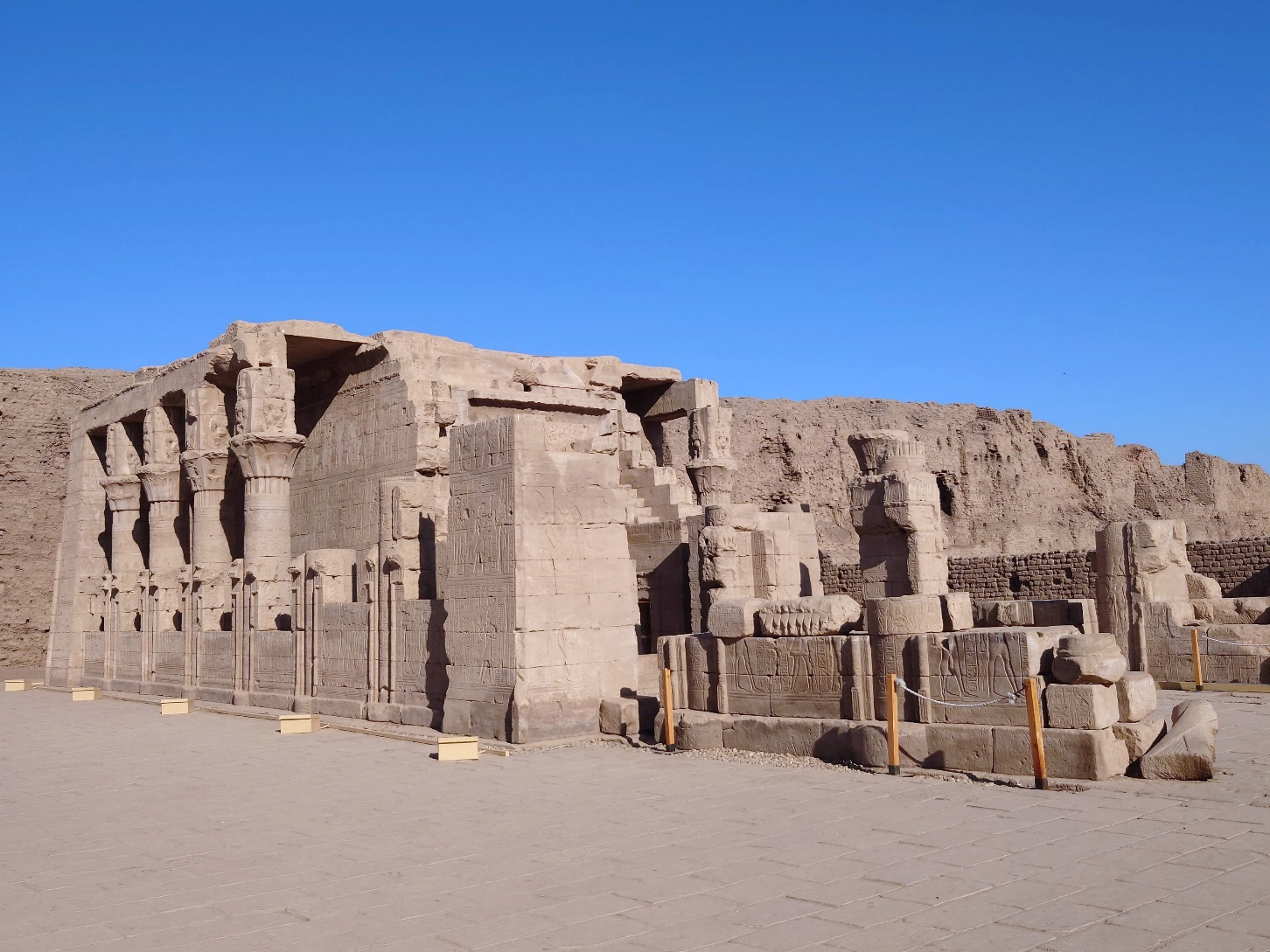
The Horus-temple complex at Edfu is the best-preserved Egyptian temple, with rich hieroglyphic inscriptions. As part of MagEIA, Martin Stadler is investigating this site with a view to understanding the ways in which the priestly practices there took place, and how the architecture of the temple (and its sister-structure, the mammisi or ‘birth-house’ [pictured below]) functioned as architectural talismans, channelling the power of the gods and of the priestly rituals taking place there. Among other topics, we discuss:
- The distinctive mythology of world-creation associated with the Edfu-temple, in which Horus is the creator-deity (among many other rôles – we reflect on the ways in which Egyptian gods could be one-yet-many in a very distinctive way),
- The complex daily rituals and cycles of yearly festivals carried out by the different classes of priests, and a discussion of the very many different types of functionaries which we tend to discuss under the rubric of ‘priest’,
- The question of whether or in what way the god-statues in Egyptian temples (as well as the divine animals and other physical divinities) were seen as being the gods themselves,
- Why Martin Stadler feels that the concepts of ‘magic’ and ‘religion’ should – against much scholarly discussion – be differentiated when discussing the ancient Egyptian temple-cult, with Edfu as a case-study. However, the real categories at play are our old friend heka, famously ambivalent in its ethical valence, and something called akh, a powerful force which is always good,
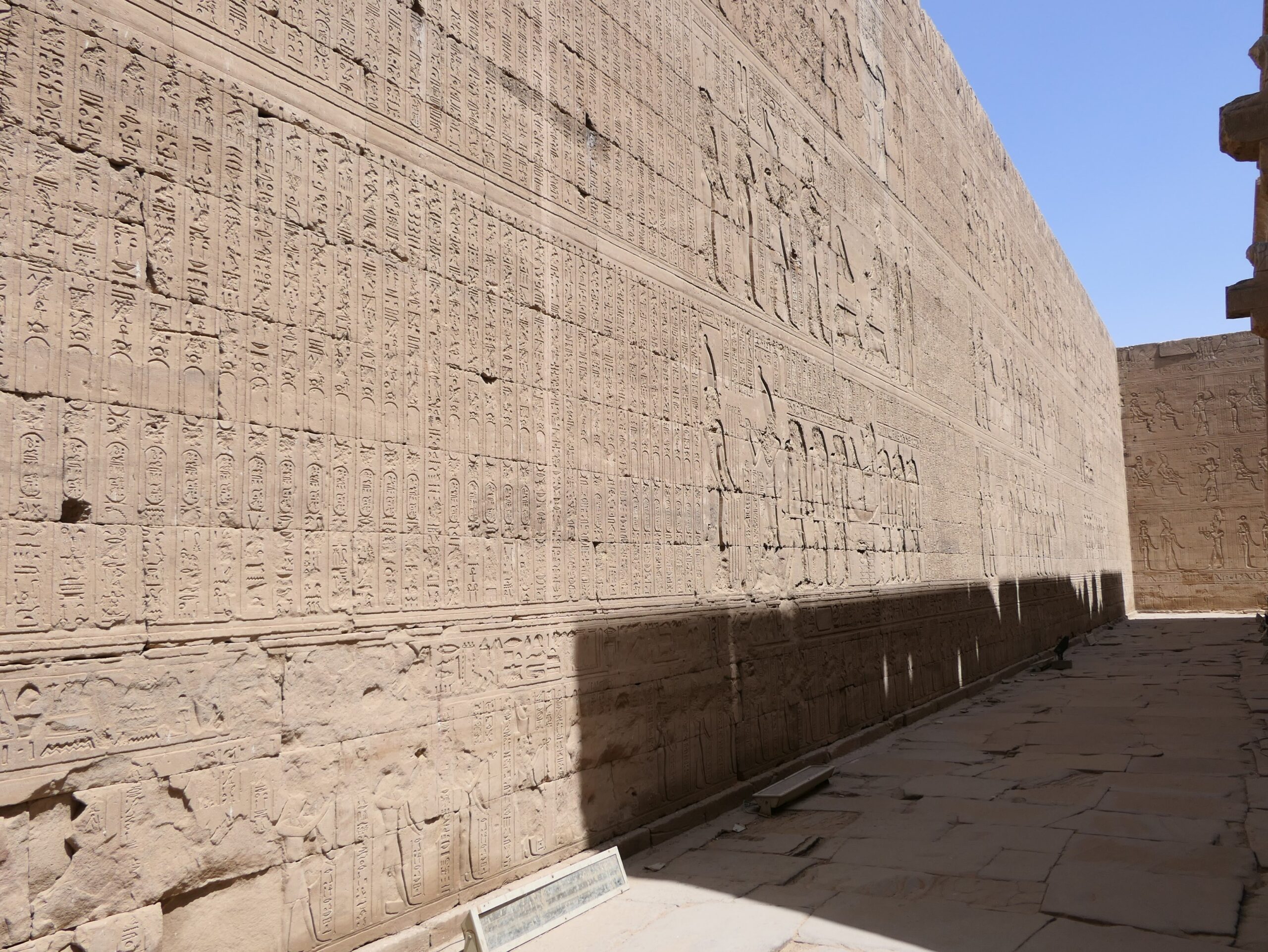
- And – perhaps the coolest finding of Stadler’s research – the ways in which the temple-inscriptions, many of them adaptations of protective spells known from other sources as well, along with site-specific texts, interact on the architectural plane to create ‘force-fields’ of magical protection for the god, his statue, and his temple.
 Interview Bio:
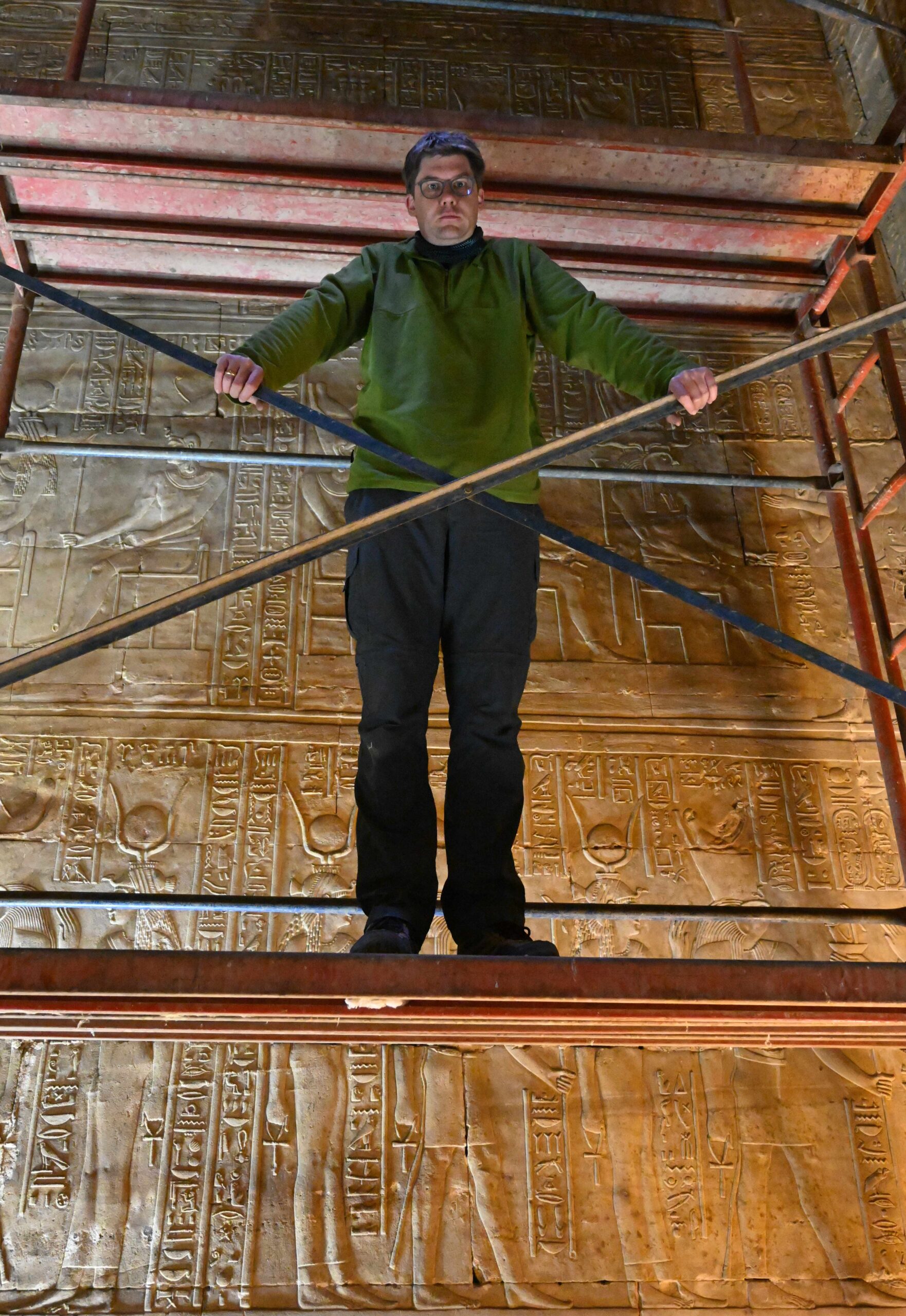
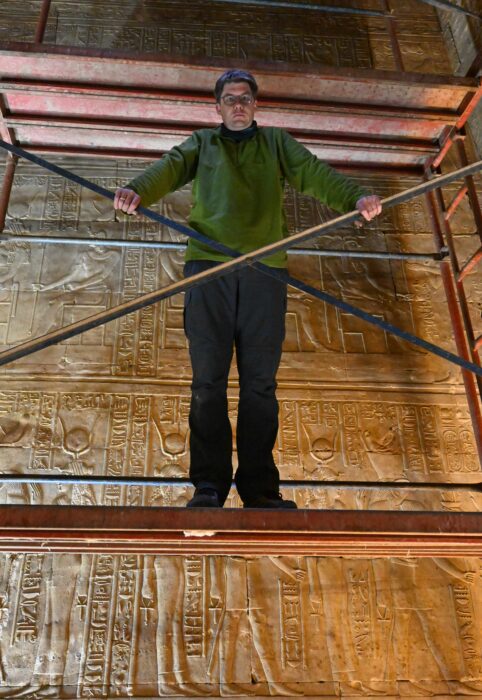
Martin Stadler is professor of Egyptology at the University of Würzburg specializing in Egyptian religion, ritual traditions and demotic literature. In phase 1 of MagEIA, he is focusing on the two apotropaic rituals sa-per (“protection of the house”) and meket-hau (“protection of the body”) in the Horus temple at Edfu, which were transferred to the temple context as adaptations of royal rituals. With its complete tradition of apotropaic rituals, the Horus temple offers a unique context that is to be systematically explored in a monographic study and made available for the understanding of comparable rituals. Stadler’s research is part of the Würzburger Edfu-Projects, which also include the Horus Behedety-Project, which he has led since 2016. As part of this project, he regularly conducts epigraphic campaigns at the Temple of Horus, the best-preserved temple in Egypt.
Works Cited in this Episode:
Alan H. Gardiner. Magic (Egyptian). In James Hastings, John A. Selbie, and Louis H. Gray, editors, Encyclopaedia of Religion and Ethics VIII, pages 262–69. T & T Clark, Edinburgh, 1915.
Denys A. Stocks. The Materials, Tools, and Work of Carving and Painting. In Vanessa Davies and Dimitri Laboury, editors, The Oxford Handbook of Egyptian Epigraphy and Paleography, pages 115–28. The University Press, Oxford, 2020.
Recommended Reading:
SHWEP Episode Recommended Reading


Bink Hallum
February 7, 2026
Hello Martin and Earl,
Thank you for this introduction to your work, Martin, and especially for your overview of temple priests and their activities.
I was struck by your discussion of text as architecture (or vice versa), temple as talisman, and particularly your description of the 3-dimensionality of the sa-per “protection of the house” text on the architrave of the mammisi “birth-house” that crisscrosses the space, with the names of four protective directional gods placed at the four corners, although their names are grouped in a single sentence when the same text was inscribed on the Horus temple.
Has a spatial comparison between the “protection of the house” text as it is inscribed on the Horus temple and on the e birth-house and discussion of its ritual significance been published yet or is this part of your fresh unpublished research?
I’m working on a set of ritually produced, talismanic, protective objects from a much later Islamic context, which also contain dispersed text that crisscrosses the talismanic space and places the names of four protective superhuman entities at the four corners, even though when the same text is written other than in the context of the talismans the four names come in a row in a single sentence.
Although I’m sure there’s no direct connection between the talismans I’m working on and the Edfu temple itself, it’s still fascinating to see that there’s a precedent for this method of arranging an operative text within a sacred space for protective purposes. A reference to published work on this would be fantastic.
Cheers,
Bink
Martin Stadler
February 12, 2026
Dear Blink,
Thank you for your interest in this episode.
The observation on the distribution of the ‘Protection of the House’ ritual on the Mammisi’s architrave is not yet published. I presented it during the first MagEIA-symposion in 2024. This paper will not be published but go into my book on the two apotropaic rituals in Edfu. This podcast is another sort of publication.
However, there is a related observation that the Egyptian temple can be considered as a ritual object, i.e. an object used during a ritual, not just the house of a ritual as has been shown by Holger Kockelmann: The reliefs showing hostile foreigners seem to have been regularly attacked in antiquity during the performance of ritual enemy destruction. The result is that in the reliefs the foreigners’ faces are now deep holes. Their destruction pattern is very different from that of post-pagan destructions of temple reliefs. For details see: Kockelmann, Holger. 2015. “Die Fremdvölkerlisten in den Soubassements der ptolemäisch-römischen Heiligtümer: Feindnamen und Feindvernichtungsrituale im Tempel zwischen Tradition und Wandel.” In: Von Meroe bis Indien: Fremdvölkerlisten Und Nubische Gabenträger in Den Griechisch-Römischen Tempeln – Soubassementstudien V, edited by Holger Kockelmann and Alexa Rickert, Studien zur spätägyptischen Religion 12. Wiesbaden: Harrassowitz, 3–141 (here esp. 117-126).
All best
Martin
Bink Hallum
February 13, 2026
Thank you, Martin. I had a feeling you might say it’s still unpublished research.
I’m looking forward to its publication, then. And for now, I’ll have to cite this episode.
Thanks for the other reference!
Cheers,
Bink