Oddcast episode
July 15, 2026
Astral Weeks. On the Planetary Order in the West
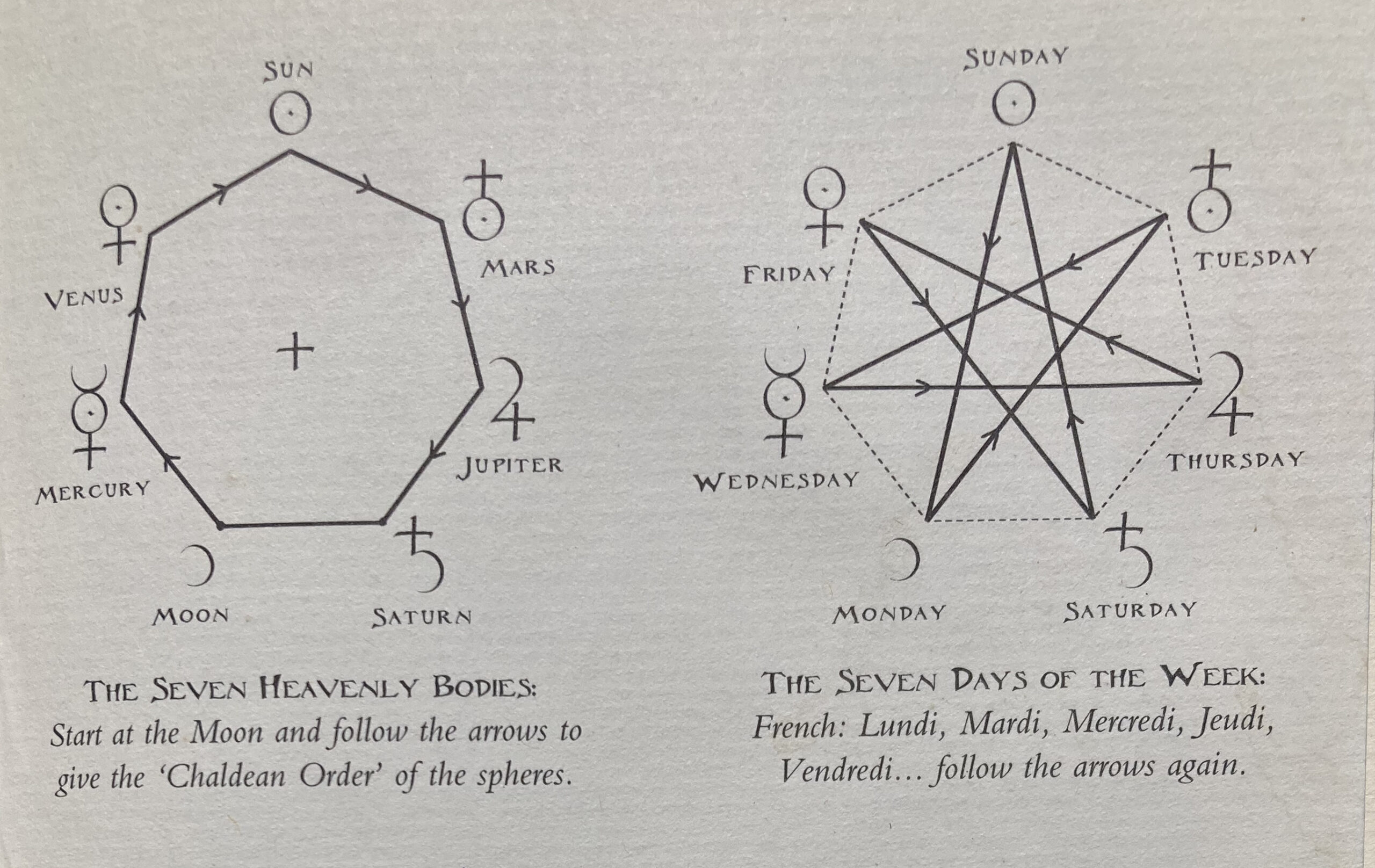
Everyone in the western world is familiar, to the point of contempt, with the days of the week; Monday notoriously sucks, Saturday is brilliant, maybe Friday, Saturday, or Sunday has a special, sacred status, depending on the religion you follow. But the week is, for everyone in the west, familiar territory. In this episode we try to make the days of the week weird again.
Why are the days of the week named after ancient star-gods? How do the planetary hours work? Questions like these are asked and answered in this episode, which seeks to be a useful primer on astrological qualitative time in the western tradition.
Works Cited in this Episode:
Primary, roughly in order of discussion:
Aristotle on the divinity of the stars as perennial belief of mankind: Metaph. 1074b1.
Macrobius on the Chaldæan and Egyptian planetary orders: In Somn. 1.19.
Plato seems to follow the ‘Egyptian’ ordering: e.g. Tim. 38d.
Vettius Valens on the planetary week and hours: Anthol. 1.10.
Secondary:
The CCAG collection referred to is: Franz Cumont and et al., editors. Catalogus Codicum Astrologorum Graecorum, 12 vols. in 20 parts. Lamertin, Brussels, 1898–1953.
Roger Beck. Planetary Gods and Planetary Orders in the Mysteries of Mithras, volume 109 of EPRO. Brill, Leiden/New York, NY/Kobenhavn/Köln, 1988.
Probable origin of the planetary week in Italy: Ilaria Bultrighini and Sacha Stern. The Seven-Day Week in the Roman Empire: Origins, Standardization, and Diffusion. In Sacha Stern, editor, Calendars in the Making: The Origins of Calendars from the Roman Empire to the Later Middle Ages, pages 10–79. Brill, Leiden, 2021, pp. 22–39.
Recommended Reading:
SHWEP Planetary Matters Recommended Reading
Themes
Aristotle, Astral Gods, Astrology, Astronomy, Hygromanteia, Macrobius, Monotheism, Pistis Sophia, Polytheism, Ptolemy, Zodiac

Comments
Comments are open to SHWEP members only
Join now to comment
Already a member? Log in here